

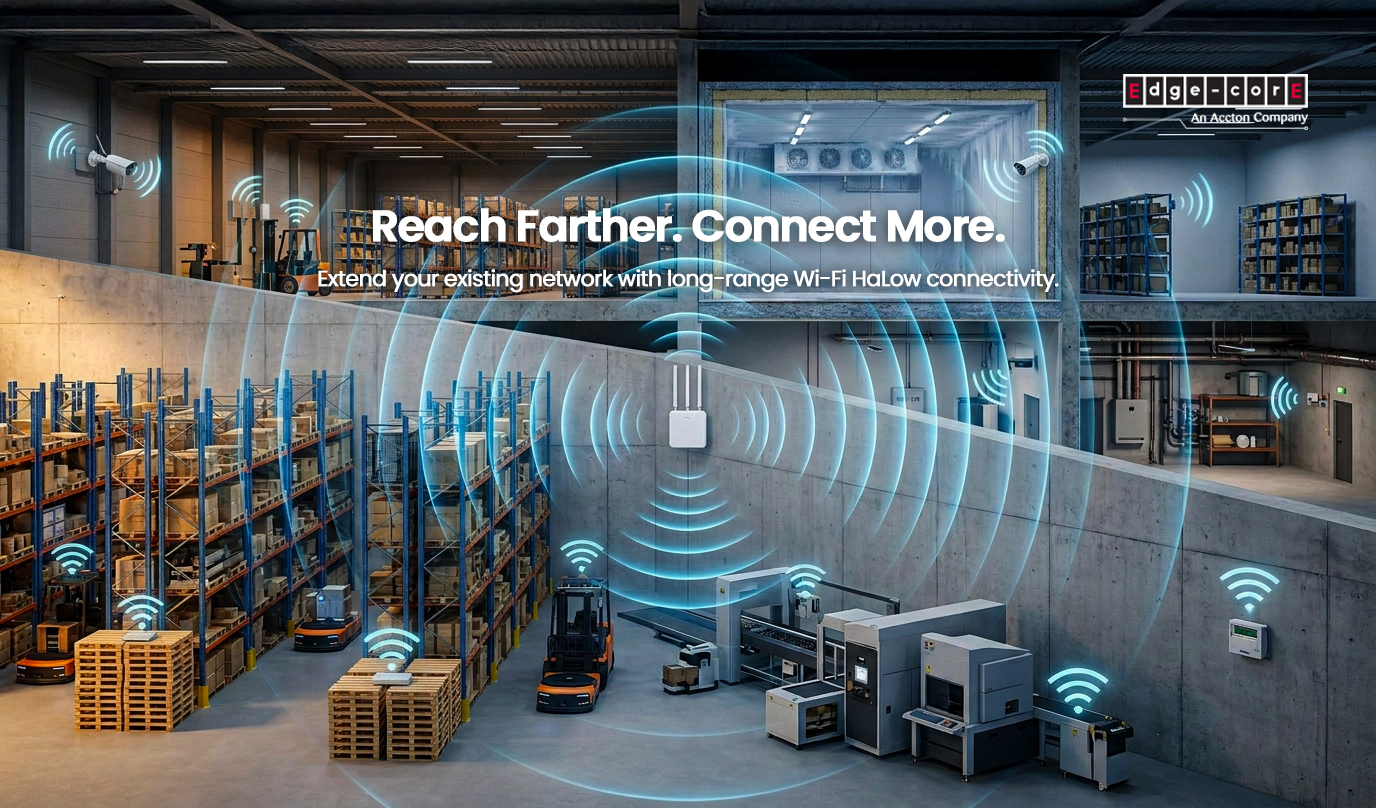
Most site networks today are not slow. They are simply not everywhere.
If you deliver managed networks or integration projects, you have seen this pattern at your customers’ sites. The front of house has solid coverage. The office runs fine. But the stockroom behind dense racking, the cold storage zone at the far end, the loading dock outside, the building across the yard, these are the places where the network stops. And when a customer asks you to connect sensors or cameras out there, the honest answer has often been complicated and expensive.
The usual options all come with a catch. Pulling new cable means construction, trenching, and interrupted operations at the customer’s site. Cellular works, but every device you add carries its own monthly fee, and that recurring cost eats into the service margin as the deployment grows.
This is the gap Wi-Fi HaLow was built to close.
What Makes Wi-Fi Halow Different
Wi-Fi HaLow (802.11ah) runs in the sub 1 GHz band. Lower frequency means two things in practice: the signal travels much farther than conventional Wi-Fi, and it passes through obstacles like dense racking, walls, and structural barriers that stop higher frequency signals. It also draws very little power, so battery operated devices can run for a long time without maintenance visits.
If you have worked with LoRaWAN or NB-IoT, the long range, low power part will sound familiar. Those technologies do that job well for devices that send a few small readings a day. Where Wi-Fi HaLow stands apart is capacity and architecture. Wi-Fi HaLow carries enough bandwidth to support video and data heavy applications, not just tiny sensor payloads. And because Wi-Fi HaLow is native IP and part of the Wi-Fi ecosystem, it fits naturally into the enterprise networks you already run. Your team keeps working with the same IP based architecture and management practices they use every day. There is no separate networking model or server layer to build and maintain.
Wi-Fi HaLow is not a replacement for the Wi-Fi networks you run today. Wi-Fi keeps doing what it does best: serving people, laptops, phones, and high bandwidth applications. Wi-Fi HaLow handles the other job, carrying data from sensors, cameras, and IoT devices across distances the existing network cannot reach.
One Ecosystem, Four Ways to Deploy It
At Edgecore Wi-Fi, we have built Wi-Fi HaLow into a complete ecosystem, so you can add long range connectivity in whatever form each customer site actually needs.
EAP112, the gateway. An enterprise grade IoT gateway that combines Wi-Fi 6, Wi-Fi HaLow, BLE, Zigbee, and Thread in one IP65 rated unit, with 4G LTE as a backup uplink. It acts as the central Wi-Fi HaLow access point that everything else connects back to.
Pi7d-C, for the devices your customers already have. A compact USB Type-C Wi-Fi HaLow dongle that adds Wi-Fi HaLow capability to existing equipment. It works in AP, client, or mesh mode, so it can turn a device into a local Wi-Fi HaLow access point, bridge a remote device back to the gateway over long range, or relay coverage across a larger site.
Wi-Fi HaLow Camera, for the places cable cannot reach. Long range wireless surveillance built for outdoor conditions, letting you put eyes on distant corners of a site without trenching cable to every camera position.
Portable IoT Gateway, for connectivity on the move. A battery operated gateway that brings Wi-Fi HaLow, Wi-Fi, and BLE/Zigbee connectivity to temporary sites, seasonal operations, or locations where fixed installation is not practical.
Everything is managed through Edgecore ecCLOUD. For an MSP, that matters in a practical way: the Wi-Fi HaLow layer sits in the same management view as the Wi-Fi networks you already operate, so extending a customer’s coverage does not mean standing up and staffing a separate technology stack.
A New Revenue Line, Built on Customers You Already Serve
For MSPs, ISPs, and integrators, this is the real opportunity. You already provide Wi-Fi services to these customers. The relationship, the contract, and the operations channel are all in place. Adding Wi-Fi HaLow on top means offering a new layer of service to accounts you already own, without the cost of winning a new customer.
Think about the requests that used to go nowhere. The warehouse monitoring project. The outdoor surveillance asks. The cross-building sensor deployment. Those used to be jobs you subcontracted or passed on. With Wi-Fi HaLow in your portfolio, they become services you deliver and bill for, running on infrastructure you already know how to manage.
Your customers do not replace their access points. They do not touch the applications already running. You add reach where reach is missing, and every new corner you connect is new, recurring value on an existing account.
The ecosystem is ready to deploy today. Gateway, dongle, and camera already work together as a complete solution, and we are extending the platform with more Wi-Fi HaLow products in the second half of 2026, so what you build on it now keeps growing in capability.
If your customers have corners their networks have never reached, this is a good time to look at Wi-Fi HaLow. Talk to us about where their coverage ends, and we will show you how to extend it.