
If you are an MSP, ISP, SaaS, or VaaS company trying to figure out how to bring AI to your customers’ sites, you already know the pressure is real. Your customers expect AI capability. Your competitors are moving. And somewhere between the cloud architecture you have today and the edge deployment you need tomorrow, there is a gap that nobody has made easy to cross.
That is exactly the problem Edgecore Praxis was built for. And the name is not an accident.
The thinking behind the name
There is a word that does not get used much in the technology industry: praxis.
It comes from ancient Greek, and it means the act of turning theory into practice. Knowing something is one thing. Actually doing it — executing it in the real world, at scale, under real conditions — is something else entirely. That distinction is exactly why we chose this name.
Because the challenge facing the edge AI industry right now is not a theory problem. The models exist. The cloud infrastructure exists. What is missing is the path from capability to deployment.
The gap between knowing and doing
Every enterprise vertical is under pressure to deliver AI-powered services. MSPs, ISPs, VaaS platforms, SaaS companies — they all see the same opportunity: AI running at the customer site, in real time, delivering real value. Most of them know what they want to build. The harder question is how to get there.
Service providers are strong at what they do. They understand their customers, their markets, and the services they provide. But hardware design, chipset selection, thermal engineering, firmware precision — these are not their core competencies, and they should not have to be. Their job is to build great services. The right partner’s job is to make sure the hardware underneath those services does not slow them down.
That is the role Edgecore Praxis was built to play.
From proof of concept to real commercial deployment
Getting edge AI from a lab bench to a real commercial service is harder than it looks. One device running in a controlled environment is very different from a thousand devices spread across customer sites with different network conditions, different physical environments, and no tolerance for downtime.
The companies that navigate this successfully are the ones with a partner that has already solved the hard operational problems. Which compute tier fits which use case? How do you keep hardware running reliably in an industrial facility with temperature swings and dust? How do you push a model update to 500 devices across 20 cities without dispatching a technician to each location?
These questions sit at the intersection of hardware, firmware, and fleet management. Answering them requires capability across all three layers. Edgecore has spent decades building enterprise networking equipment that operates under exactly these conditions. That same engineering discipline is the foundation of every Praxis hardware decision, and it extends into the management infrastructure that runs across the entire fleet — OTA firmware upgrades, remote model deployment, device health monitoring at scale. These are the capabilities that turn edge AI from a technically interesting concept into a commercially viable service.
The three problems Praxis is built to solve
The service providers we talk to face versions of the same three challenges.
- Bringing AI to infrastructure that was never designed for it
Most end customers already have hardware deployed at their sites — cameras, sensors, gateways — equipment that was specified before AI was part of the conversation. The technology companies serving these customers need a way to add AI capability without asking their customers to start over. A low-cost, manageable Edge AI Box placed alongside existing equipment gives them that path. No rip and replace. No operational disruption. Just AI capability added to what is already there. - Moving inference from the cloud to the edge
Running AI inference entirely in the cloud means paying for data transmission and compute on every query, at every site, every day. As a service scales, those costs compound. Moving inference to the edge means processing data where it is generated, so only meaningful outputs travel to the cloud. For service providers whose margins are tied to cloud spend, this is a structural business improvement that gets better as their customer base grows — not just a technical architecture decision. - Keeping sensitive data where it belongs
Healthcare, finance, government, enterprise security — there are entire market segments where data cannot leave the premises, whether due to regulatory requirements, contractual obligations, or customer trust. Cloud-only AI architectures cannot serve these customers. Edge inference can. Running AI locally means the data stays local, and service providers gain access to markets that were previously out of reach.
Ready to move from idea to deployment?
If any of these challenges sound familiar, we would like to talk.
Edgecore Praxis is designed for technology companies that are serious about bringing AI to the edge — and need a hardware and engineering partner that can move with them. Whether you want to validate the platform against your deployment requirements or just start the conversation about where Praxis fits in your stack, we are ready.
Contact us to request an evaluation sample or schedule a technical discussion.
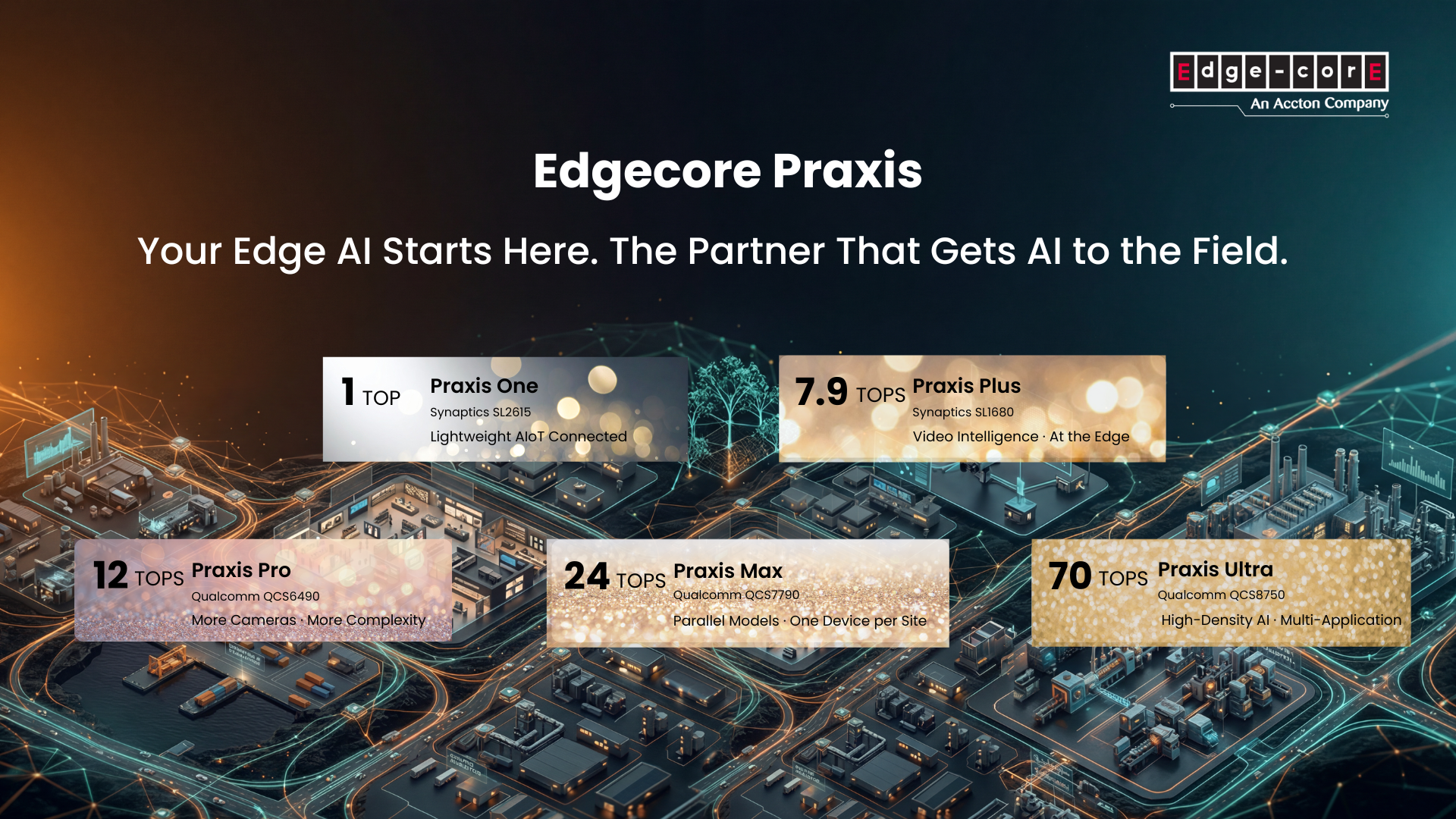
Edgecore Praxis is a curated Edge AI platform spanning five compute tiers from 1 to 70 TOPS.