
OpenLAN is a simple idea with significant implications. Defined under the TIP (Telecom Infra Project) initiative, it is an open architecture framework that disaggregates the network stack, letting operators build enterprise-grade networks from best-of-breed components, without being locked to any single vendor’s ecosystem.
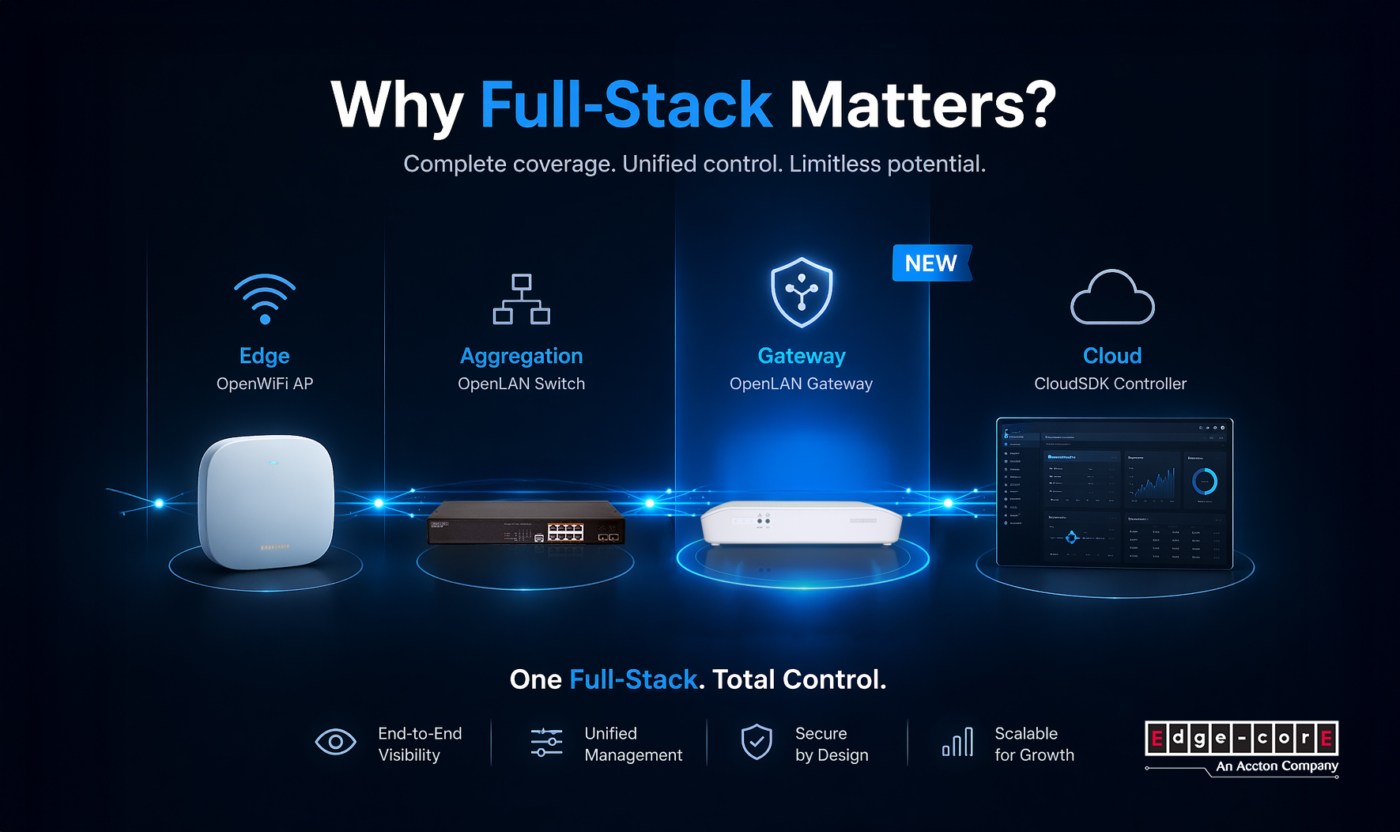
In practice, OpenLAN covers the layers that matter most in a campus or enterprise deployment. OpenWiFi defines the access point layer. OpenLAN Switching (OLS) covers wired aggregation. The CloudSDK Controller provides unified management across both. For operators who have adopted this stack, the difference is tangible: real hardware flexibility, API-driven automation, and a management plane they fully own, from the switch port to the wireless client.
This is a strong foundation. The question worth asking is what the stack looks like as it grows more complete.
Completeness Compounds Value
Open architecture stacks tend to follow a consistent pattern. Each additional layer that joins the framework extends what operators can do, not just at that layer, but across the whole system. When OLS joined the OpenWiFi story, it was not simply about adding a managed switch. It enabled consistent policy enforcement from the wired port to the wireless client. It made zero-touch provisioning across the full LAN practical. The stack became more capable because it became more coherent.
The same logic applies as OpenLAN extends to the WAN edge with the addition of OpenLAN Gateway (OLG). Routing, VPN, firewall, QoS: these functions have always existed in operator networks, but outside the OpenLAN management plane. When the gateway layer joins the stack, the CloudSDK Controller’s reach extends from WAN entry all the way to the wireless client. Provisioning, monitoring, and automation now span the full path. The value is not just in the gateway itself. It is in what a more complete stack enables across every layer beneath it.
Open Software Opens a Different Dimension
There is a second dimension to OLG that goes beyond architectural completeness, and it speaks to what open-source infrastructure means in practice.
When the gateway runs open software, operators are not limited to what a vendor ships. The platform is extensible. An MSP can deploy custom monitoring or security applications at the network edge, building differentiated services on top of commodity hardware. An ISP can run local analytics without routing data through a third-party cloud. An enterprise can integrate security tooling they already own and operate. The gateway becomes a programmable edge platform, not just a routing appliance.
This extensibility is the point. Open architecture at its most valuable is not just about hardware choice or TCO reduction. It is about giving operators the freedom to build the software layer that defines their service. A more complete OpenLAN stack, with an open-source gateway at the edge, is a stack where that freedom reaches further than before.
The Direction of Travel
The OpenLAN ecosystem is still evolving. New hardware joins the certified portfolio. Tooling improves. Operational knowledge accumulates across the community. Each contribution strengthens the whole. OLG is part of that progression, another layer coming under the same open architecture principles that have made OpenWiFi and OLS compelling in the first place.
At Edgecore Wi-Fi, we have been building toward this. We already deliver OpenWiFi APs, OLS switches, and a CloudSDK-compatible controller as a validated, integrated stack. Adding OLG is the next step, one that will make a complete OpenLAN full-stack solution, from gateway to wireless client, a reality that operators can deploy today. That moment is here, and we are looking forward to sharing what that looks like.