Edgecore Wi-Fi is excited to announce that our latest AP firmware release now supports the MQTT (Message Queuing Telemetry Transport) protocol, providing enhanced communication efficiency for a wide range of IoT deployments. With this update, administrators can easily choose between HTTP and MQTT transmission modes directly through the ecCLOUD interface—enabling greater flexibility based on network conditions and use case requirements.
From Industrial Roots to IoT Standard: A Brief History of MQTT
MQTT was originally developed in 1999 by engineers at IBM and Arcom (now Eurotech) to monitor oil pipelines over satellite networks. The core goal was to create a lightweight protocol that could transmit telemetry data over high-latency, low-bandwidth, and unreliable networks. Built on a publish-subscribe model, MQTT enabled devices to communicate asynchronously and efficiently.
Although it was not initially designed for IoT—since the term wasn’t widely used back then—MQTT’s core attributes made it perfectly suited for connected devices. As IoT adoption surged, MQTT organically became a go-to protocol for many developers and enterprises due to its simplicity, low overhead, and real-time delivery capabilities.
HTTP vs. MQTT – What’s the Difference?
HTTP operates using a request-response model, which requires devices to continuously initiate connections to send or receive data. This can lead to higher latency and inefficiencies, especially in scenarios where data must be sent frequently or where devices operate under constrained power and bandwidth.
MQTT, on the other hand, uses a lightweight publish-subscribe model that allows devices to send messages to a broker, which then distributes the data to subscribers. This model significantly reduces network load, supports real-time data updates, and is ideal for battery-powered IoT devices.
Given that MQTT is one of the most widely adopted protocols in the IoT ecosystem, Edgecore Wi-Fi Aps can now directly publish data to customers’ existing MQTT-based IoT management servers – without requiring additional integration layers or protocol converter. Moreover, the administrators can configure Edgecore Wi-Fi access points via ecCLOUD to use either HTTP or MQTT as the transmission protocol. Once configured, the device will send telemetry data directly to the customer’s designated IoT management server or application.
How to Enable MQTT in ecCLOUD
To enable MQTT communication in ecCLOUD:
- Go to the Site Level interface in ecCLOUD, then select Configuration from the left menu and click Wi-Fi 6 & Newer.
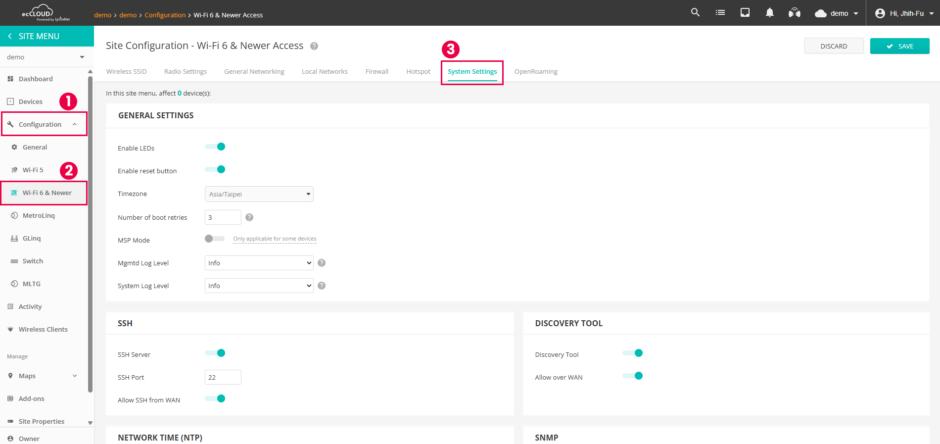
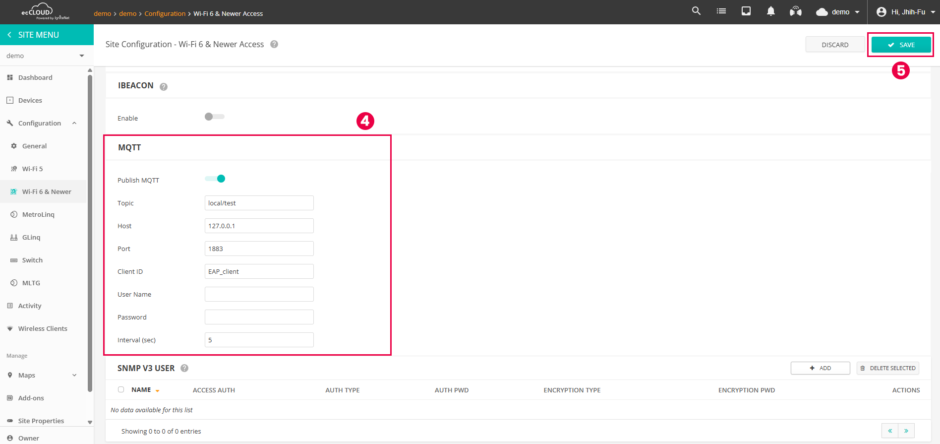
- Under System Settings, locate the MQTT configuration section. Enable Publish MQTT, fill in the required MQTT parameters, and click Save in the top right corner.
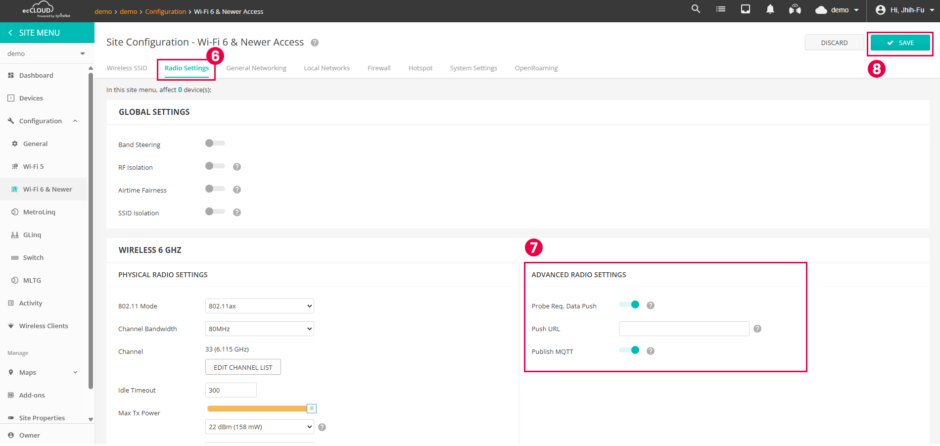
- Navigate to Radio Settings. In the right-hand column under Advanced Radio Settings for each wireless band, enable both Probe Req. Data Push and Publish MQTT, and click Save. You can use both HTTP (Push URL) and MQTT simultaneously for data transmission.
- To enable BLE data publishing, go back to System Settings and enter the BLE Scan configuration section. Enable both BLE Probe Req. Data Push and Publish MQTT, then click Save.
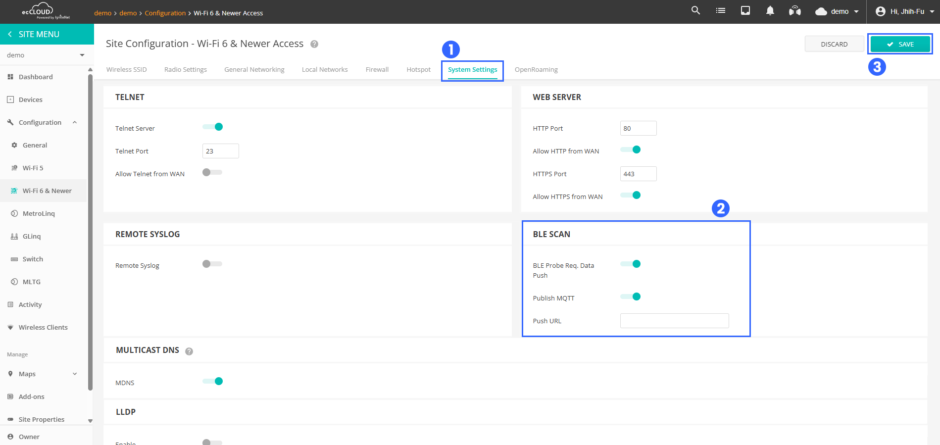
This allows your devices to publish Wi-Fi and BLE scan data over MQTT in real time, while also supporting HTTP if needed.
MQTT for IoT: Real-Time, Lightweight, and Scalable
MQTT’s design makes it particularly well-suited for IoT systems. It facilitates continuous, low-latency communication between large numbers of devices and central services. It also enables more dynamic network architectures, allowing devices to connect and disconnect without disrupting the overall data flow.
In an IoT environment, MQTT is used to transmit real-time telemetry data between devices and the IoT management server with minimal overhead. This includes:
• Device health and connectivity: device signals, uptime, and status reports
• Wi-Fi scan results: collected through active probe requests, detecting nearby access points and their signal strength (RSSI), which can be used to estimate a device’s location
• BLE scan data: gathered via passive listening to advertising packets from nearby beacons or tags, ideal for high-precision indoor proximity detection
• Environmental sensor data: such as temperature, humidity, or air quality
These data types form the foundation for a wide range of IoT applications:
• Smart building management: Analyze occupancy and movement patterns using Wi-Fi/BLE scans to optimize lighting or space utilization.
• Asset tracking: Monitor the location and movement of medical equipment or warehouse goods using BLE beacon proximity and MQTT reporting.
• Remote monitoring: Deploy low-power sensors in industrial or agricultural fields to report environmental conditions over MQTT.
• Fleet and logistics: Track mobile assets with real-time location, status, and telemetry data via MQTT, using both Wi-Fi and BLE scanning.
By integrating MQTT support into access points, Edgecore Wi-Fi continues to expand the AP’s capabilities to meet the growing demands of IoT environments. Whether you’re tracking assets indoors, monitoring remote devices, or developing smart infrastructure solutions, MQTT enables secure, efficient, and scalable communication with your connected devices.
📢 Stay tuned for our updates as we continue to introduce new features and expand ecCLOUD and APs capabilities for enhanced IoT management!